


 Invest ideas
News
9 Jun 2026, 13:10
TON Foundation Confirms Toncoin Rebrand to Gram, Effective June 15
BitcoinWorld TON Foundation Confirms Toncoin Rebrand to Gram, Effective June 15 The Open Network Foundation (TON) confirmed via its official X account that its native token, Toncoin, will officially rebrand to Gram on June 15. The decision, approved by 81.22% of the community vote, marks a return to the token’s original name abandoned during past regulatory disputes with the U.S. Securities and Exchange Commission (SEC). Rebrand Details and Timeline According to the foundation’s announcement, the ticker will change from TON to GRAM at precisely 8:00 p.m. UTC on June 15. The foundation clarified that the blockchain itself will continue to be called The Open Network. Only the token’s name, ticker, and icon are being updated. The change does not affect the network’s underlying technology or existing token holders. The move follows a recent declaration by Telegram CEO Pavel Durov, who publicly advocated for returning the token to its original Gram branding. Durov’s statement earlier this year signaled a strategic pivot to reclaim the project’s early identity, which was shelved in 2020 after the SEC halted Telegram’s $1.7 billion Gram token sale, alleging unregistered securities offering. Background: From Gram to Toncoin and Back The Gram token was originally conceived as the native currency for Telegram’s blockchain platform, TON. However, after the SEC intervention, Telegram abandoned the project in 2020, and the community-driven TON Foundation rebranded the token to Toncoin to distance itself from the legal battle. The SEC case was eventually settled, with Telegram agreeing to return $1.2 billion to investors and pay an $18.5 million civil penalty. Now, with renewed regulatory clarity and a growing decentralized ecosystem, the foundation sees the rebrand as a way to honor the project’s roots while moving forward. The vote, which saw strong community support, reflects a desire to reclaim the original brand equity associated with the Gram name. Market and Community Implications For token holders, the rebrand is primarily cosmetic. Wallets, exchanges, and decentralized applications will need to update their interfaces to reflect the new ticker and icon. The foundation has stated that no action is required from users, as the transition will be handled automatically by infrastructure providers. However, traders should be aware that price feeds and listing pages may temporarily display both tickers during the transition period. The rebrand also carries symbolic weight. By returning to the Gram name, the TON Foundation signals a new chapter of regulatory compliance and mainstream acceptance. It also strengthens the brand’s association with Telegram, which, despite its legal separation, remains the network’s largest user base and most prominent advocate. Conclusion The Toncoin-to-Gram rebrand on June 15 represents a full-circle moment for one of the most closely watched blockchain projects in crypto. While the change is largely symbolic, it underscores the TON Foundation’s commitment to community governance and its effort to rebuild trust after the SEC conflict. Investors and users should prepare for the ticker update but can expect no disruption to the network’s functionality. FAQs Q1: Will my Toncoin tokens automatically convert to Gram? Yes. The rebrand is automatic. No action is required from token holders. Exchanges and wallets will update the ticker and icon on June 15 at 8:00 p.m. UTC. Q2: Why did the TON Foundation decide to rebrand back to Gram? The decision followed a community vote where 81.22% approved the change. It also aligns with Telegram CEO Pavel Durov’s public support for returning to the original Gram name, which was abandoned after the SEC lawsuit in 2020. Q3: Does the rebrand affect the blockchain or smart contracts? No. Only the token’s name, ticker, and icon are changing. The Open Network blockchain remains unchanged, and all smart contracts, dApps, and balances will continue to function normally. This post TON Foundation Confirms Toncoin Rebrand to Gram, Effective June 15 first appeared on BitcoinWorld .
4 Jun 2026, 18:56
RLUSD Expands Its Multi-chain Presence Through Wormhole

Ripple has announced that it is expanding its presence on multiple chains by using Wormhole’s Native Token Transfers (NTT). RLUSD will use the burn-and-mint process, which helps it to maintain its ratio of 1:1 with USD. The announcement comes amid a growth in the overall stablecoin market thanks to growing regulatory clarity. On June 4, Ripple, the leading blockchain infrastructure, announced the multi-chain expansion of its native stablecoin, RLUSD, by using Wormhole’s Native Token Transfers (NTT). After its launch in 2024, this announcement is a major expansion for the RLUSD. The stablecoin is designed to meet various purposes, such as cross-border payments, institutional on/off-ramps, and tokenization use cases. The integration of the cross-chain bridge will increase the presence of Ripple’s native stablecoin on various Ethereum Layer 2 networks and related chains. Wormhole Supports RLUSD’s Multi-Chain Push Wormhole is a major cross-chain bridge, which is used to connect different blockchain networks. Ripple will use Wormhole’s Native Token Transfers (NTT). This is different from the other bridges that create wrapped versions of tokens. The NTT standard will allow Ripple to issue and control its RLUSD stablecoin directly on each blockchain. On the Wormhole bridge, users can transact RLUSD from one blockchain to another blockchain by using the system, where tokens are burned on the source chain and issued in the destination chain. This kind of mechanism allows the stablecoin to maintain its backing with USD, Treasury securities, and cash equivalents. RLUSD is also known for its compliance with digital asset regulation with great transparency. The integration will improve the liquidity with low-cost transactions. This will help it to avoid the problems of fragmented or synthetic assets by allowing the native movement of RLUSD across different blockchains. Stablecoin Market Soars with Growing Regulatory Clarity The recent regulatory developments around the digital sector, like the GENIUS Act and CLARITY Act, have helped the stablecoin market to grow. According to DeFiLIama , the cumulative market capitalization of stablecoins has soared to around $320 billion. RLUSD was launched in December 2024 on the XRP Ledger and the Ethereum network. It has grown steadily because of its regulated status. As of now, the stablecoin is holding $1.74 billion in total market capitalization with its presence on the XRP Ledger and the Ethereum blockchain network, according to rwa.xyz . RLUSD is one of the most regulated stablecoins available in the market. Many institutions are planning to integrate these stablecoins to enhance cross-border transactions. Ripple’s stablecoin is also standing out in oversight from New York’s Department of Financial Services (NYDFS) trust company. Ripple has also applied for a federal OCC charter for even stronger dual regulation. Recently, Mastercard also revealed its plan to increase its integration with the XRP Ledger (XRPL) in order to enhance support for settlement capabilities.
4 Jun 2026, 02:35
Drift to Rebrand as Solana Perp Exchange After $295M Hack, Appoints New Security Lead
BitcoinWorld Drift to Rebrand as Solana Perp Exchange After $295M Hack, Appoints New Security Lead Drift (DRIFT), the decentralized exchange that suffered a catastrophic hack of approximately $295 million in April, has announced a comprehensive rebranding strategy. The company will relaunch as a Solana-based perpetual futures exchange, with a renewed focus on security and user compensation. Rebranding and New Focus In a statement released today, Drift confirmed that it will rebrand as a USDT-based perpetual futures trading platform. All revenue generated by the new platform will be directed into a dedicated fund to compensate users affected by the April exploit. The move marks a significant strategic pivot for the protocol, which was previously known for its broader decentralized finance (DeFi) offerings on Solana. New Leadership and Technical Support To spearhead this security overhaul, Drift has appointed Noah Prince as its new Protocol Lead. Prince previously served as the engineering lead at Helium Protocol, a decentralized wireless network, where he gained a reputation for robust system architecture. Additionally, the exchange will receive technical support from team members at Gauntlet, a firm specializing in decentralized finance modeling and risk management. Gauntlet’s involvement is expected to provide advanced stress-testing and economic security analysis for the new platform. Why This Matters for Users and the Solana Ecosystem The April hack, one of the largest in Solana’s history, severely damaged user trust and raised questions about the security of DeFi protocols. Drift’s decision to rebrand entirely, rather than simply patch the existing system, signals a recognition that a fundamental change in approach is necessary. For the Solana ecosystem, the successful relaunch of a secure perpetual futures exchange is critical for restoring confidence in the network’s ability to host high-value financial applications. The focus on a single product—perpetual futures—also suggests a move toward specialization, which could help Drift compete more effectively against established players like dYdX and GMX. User Compensation Plan Drift has stated that details of its user compensation plan will be released at a later date. The company has not yet specified whether compensation will be paid in the form of native tokens, stablecoins, or a combination of both. The decision to allocate all future platform revenue to the compensation fund is a notable commitment, though the timeline for full repayment remains unclear. Conclusion Drift’s rebranding as a Solana-based perpetual futures exchange represents a high-stakes attempt to recover from one of the most significant security breaches in DeFi history. With new leadership from Helium and technical backing from Gauntlet, the platform is betting on a security-first approach to win back user trust. The coming weeks will be critical as the company unveils its compensation plan and demonstrates whether its new architecture can withstand the scrutiny of a skeptical market. FAQs Q1: What exactly happened in the Drift hack? A: In April, Drift suffered a security breach that resulted in the loss of approximately $295 million in user funds. The exploit targeted vulnerabilities in the protocol’s smart contracts, leading to the unauthorized withdrawal of assets. Q2: When will the new Drift platform launch? A: Drift has not announced a specific launch date for the rebranded perpetual futures exchange. The company is currently in the development and security audit phase, with details expected to be shared in the coming months. Q3: Will all affected users be compensated? A: Drift has committed to using all revenue generated by the new platform to fund user compensation. However, the exact details of the compensation plan, including eligibility criteria and payout schedule, have not yet been released. The company has stated that this information will be provided at a later date. This post Drift to Rebrand as Solana Perp Exchange After $295M Hack, Appoints New Security Lead first appeared on BitcoinWorld .
3 Jun 2026, 08:41
TAO’s Subnet Test: Why Bittensor Needs Utility Beyond AI Rotation

AI narratives can attract capital, but they rarely sustain it. TAO’s recent swings have reinforced a hard truth for Bittensor: long-term value must come from subnets that deliver tangible, repeatable utility, not from rotation alone. This article maps how to evaluate that utility and what the latest governance changes mean in practice. If you build on, operate, or allocate to Bittensor, your decision now is less about “AI exposure” and more about subnet economics: who pays, for what, and how value returns to TAO. We outline the mechanics, a practical playbook, and the red flags to avoid. We also integrate new governance and market context—from convective locking changes to a sharp price move —so you can translate on-chain signals into better choices. AspectWhat to KnowMarket backdropOn 2026-06-03, CMC AI flagged TAO down 12.70% to $221.07 (24h), with elevated derivatives activity underscoring event-driven volatility ( CoinMarketCap ).Governance shiftSubtensor Conviction v2 moved to devnet-ready with decaying locks; PRs #2687 and #2696 merged, setting 648,000 blocks (~60-day half-life). Mainnet PR #2643 remained open/blocked as of late May ( Taostats documentation (Conviction) ).Commitment signalsA SubnetRadar snapshot showed ~4.58M α locked, ~4.14M α counted as conviction, 16 active lockers; top convict SN79 (MVTRX) held 1.27M α—early evidence of operator commitment ( Tao Outsider (SubnetRadar snapshot) ).Stress eventCovenant AI’s April exit involved selling ~37,000 TAO of α tokens and sparked a sharp selloff and governance urgency across the network ( Tao.media ).Core questionCan subnets generate durable, paid demand (inference, data, compute routing) that feeds TAO value beyond short-lived AI rotations?Who should careSubnet owners/operators, data/model providers, validators, allocators, and enterprises testing decentralized AI services.Action nowTrack Conviction v2 rollout, read per-subnet demand metrics, and back operators with clear customers and verifiable performance. Core concepts that matter for TAO’s next phase Bittensor coordinates open, competitive markets (subnets) where miners provide AI-related services—such as inference, dataset curation, or retrieval—and validators score their usefulness. Rewards flow to the most useful work. That design is elegant, but the investment thesis only compounds if subnets meet real demand and route value back to TAO holders and builders. AI token rotations can lift all boats temporarily. The sustainability test is different: do end users—startups, data teams, model engineers—rely on a subnet because it is cheaper, faster, or more resilient than centralized alternatives? If yes, usage should translate into pricing power for providers, clearer validator economics, and more predictable returns for capital that locks into subnet ecosystems. Governance is evolving to align that capital. Conviction v2 introduces decaying locks aimed at longer-term commitment without permanent bondage. In theory, that stabilizes subnet stewardship and dampens mercenary churn; in practice, it depends on the lock parameters, distribution of lockers, and whether commitment correlates with service quality. For allocators, the key is to evaluate subnets like early-stage platforms: identify a paying user base, verify the throughput and latency they require, and map token mechanics (α-to-TAO pathways, emissions, fees) to a plausible return profile. For builders, the mandate is simpler: deliver a service people repeatedly pay for. Glossary: Bittensor and subnet economy TAO — The native token that secures the network and underpins staking, rewards, and governance across subnets. Subnet — A specialized market inside Bittensor where miners provide a focused service (e.g., inference) and validators score outputs. α (alpha) tokens — Per-subnet accounting units or derivatives used in some governance and economic mechanisms around subnet participation. Conviction v2 — An upgraded locking and voting model with decaying locks to align long-term commitment while allowing gradual liquidity return. Validator — Node that assesses miners’ outputs and influences reward allocation according to usefulness. Emissions/fees — Token flows that reward useful work or accrue from paid usage, forming the economic backbone of each subnet. A practical playbook for builders, operators, and allocators Define the user and job-to-be-done. Write a one-line user story (e.g., “LLM ops team needs low-latency inference with predictable throughput”) and verify it with at least two real prospects. Quantify demand-side metrics. Track request counts, latency SLOs, error budgets, and willingness to pay. If a subnet can’t publish these, assume demand is unproven. Map the value path to TAO. Diagram how fees, emissions, or α mechanics link usage to TAO accrual or reduced sell pressure; if the path is hand-wavy, pass. Audit governance and locks. Review Conviction v2 parameters and current lockers per subnet. Decaying locks (e.g., 648k blocks ≈ 60-day half-life in devnet updates) change liquidity timing and control. Stress-test operator concentration. Check whether a few lockers or validators can gatekeep upgrades or capture emissions. Concentration raises governance risk. Pilot with staged exposure. Start with a small allocation or limited deployment, measure outcomes for 2–4 weeks, then scale only if KPIs improve. Hedge event risk. Expect volatility around governance and subnet events; size positions accordingly and consider derivatives hedges off-chain if available. Set pre-committed exits. Define objective thresholds (latency, user growth, governance transparency) that trigger a scale-up or unwind, and stick to them. The “Subnet Test”: Turning AI buzz into durable demand To justify TAO at scale, subnets need customers, not just miners and validators. The durable-demand checklist looks like this: a repeatable workload; clear latency and cost advantages over centralized providers; and credible, verifiable performance data. If a subnet can demonstrate those consistently, emission subsidies matter less over time and the economics can tilt positive. Consider three archetypes likely to pass the test sooner: Inference marketplaces for LLMs and niche models. They win if they beat centralized APIs on price/performance or offer censorship resistance and uptime diversity (multi-provider routing). Retrieval and data curation layers. If they generate demonstrably higher model quality or faster iteration cycles for fine-tuning, data teams will pay. Compute orchestration and routing. If a subnet reliably finds cheap, available GPUs and allocates jobs with SLAs, it can undercut cloud burst pricing. By contrast, speculative subnets without real workloads become reflexive: token incentives attract supply, validators score outputs of limited external value, and the flywheel spins until emissions fade. The moment macro AI rotation cools, these markets unwind fast. Pro tip: Treat every subnet like a startup. Demand diligence outranks token design. Ask to see real dashboards: request volume, p95 latency, paying logos, and incident reports. Conviction v2, decaying locks, and what to read on-chain Late May brought meaningful progress on Bittensor’s governance mechanics. Subtensor PR #2687 (Conviction v2 updates) and PR #2696 (setting unlock/maturity to 648,000 blocks, about a 60-day half-life) were merged, moving Conviction v2 to devnet-ready status with decaying locks; the mainnet deployment PR #2643 remained open/blocked at that time ( Taostats documentation (Conviction) ). Why it matters: decaying locks alter the incentive for long-term stewardship without freezing capital indefinitely. A locker’s influence and liquidity both change predictably over time, creating a gradient instead of a cliff. Subnets where owners/operators publicly lock and maintain rising conviction signal skin in the game. We already have early on-chain signals. A SubnetRadar snapshot cited by Tao Outsider showed roughly 4.58M α locked, about 4.14M α counted as conviction, with 16 active lockers; the top convict leader, SN79 (MVTRX), held 1.27M α—suggesting concentrated, but visible, commitment in the early phase ( Tao Outsider (SubnetRadar snapshot) ). Balance that against tail risk. In April, Covenant AI exited Bittensor, reportedly selling approximately 37,000 TAO of α tokens; the episode triggered a sharp selloff and immediate governance focus across the ecosystem ( Tao.media ). Coupled with price and derivatives activity flagged on June 3 by CMC AI, these events illustrate how governance and subnet developments can transmit quickly to markets ( CoinMarketCap ). How to interpret: watch the distribution of conviction across lockers and the cadence of new lockers joining. A healthy pattern is broadening participation, steady or rising conviction totals, and sustained endpoint performance. A fragile pattern is one or two dominant lockers, falling conviction, and widening spreads between promised and observed service quality. Builders vs. backers: choosing your exposure Exposure to Bittensor can range from passive to deeply operational. Match your choice to your edge—capital, engineering, distribution, or governance fluency—and to your tolerance for event-driven volatility. Exposure pathCapital/skill needsMain risksUpside driversTypical horizonHold TAOLow ops; portfolio risk managementMarket and governance shocks; rotation cyclesNetwork-wide utility growth; improved token sinksMedium–longLock α in selected subnetsGovernance reading; on-chain trackingConcentration of lockers; parameter changes; liquidity decaySubnet-specific demand; aligned operatorsMediumOperate a subnetEngineering, DevOps, BD, and communitySLA failures; validator capture; regulatory questionsFee revenue; emissions; reputation moatLongProvide inference/data servicesModel quality; GPU capacity; monitoringPerformance drift; cost spikes; competitionThroughput and reliability; customer retentionShort–medium For allocators, the differentiator is diligence on the demand side. For builders, it’s operational excellence and transparent reporting. Both groups benefit from reading governance repos, tracking conviction, and correlating it with real service metrics. When these line up, TAO has a shot at escaping the gravity of AI rotation. SubnetRadar Conviction leaderboard (snapshot May 30, 2026) showing total alpha locked and the top subnet (SN79 MVTRX) with 1.27M α — a concrete on‑chain visualization of Conviction locks and early alignment signals. — Source: SubnetRadar (screenshot hosted on Tao Outsider) Pitfalls and red flags to avoid Top-heavy conviction. If one or two lockers dominate, governance capture risk rises and exit cascades can be brutal. Unverified usage claims. Screenshots aren’t data. Ask for raw request counts, latency percentiles, and uptime history. Parameter complacency. Treat Conviction v2 as evolving; mainnet timing and details matter. Model liquidity with current block assumptions. Event-blind sizing. Governance and subnet events have translated to sharp price/derivatives moves; size positions accordingly. Opaque cost structures. If a subnet can’t explain GPU, storage, and bandwidth costs, margins likely vanish at scale. Validator quality drift. Weak or misaligned validators can inflate “usefulness” without real-world benefit. For ongoing coverage and contextual analysis around decentralized AI markets, Crypto Daily tracks governance shifts, builder activity, and cross-market flows in one place. Visit Crypto Daily for updates. Frequently Asked Questions What does Conviction v2 change for subnet participants? Conviction v2 introduces decaying locks designed to align long-term commitment while gradually returning liquidity. Recent devnet-ready updates set unlock/maturity to 648,000 blocks (about a 60-day half-life), with mainnet deployment still pending as of late May per public repos and documentation. This shifts governance power and exit timing for lockers and should reduce abrupt cliffs. How did Covenant AI’s exit impact Bittensor? According to reporting, Covenant AI sold roughly 37,000 TAO of α tokens during its April 9–10 exit. The episode coincided with a sharp selloff and catalyzed governance urgency across the ecosystem, reinforcing how concentrated positions and liquidity profiles can translate into fast market moves. Why is TAO so sensitive to governance and subnet news? Because Bittensor’s value accrues through subnet performance and community governance, changes to locks, validator rules, or operator composition can materially alter expected cash flows and risk. Recent price/derivatives activity highlighted by CMC AI shows how such events transmit quickly to TAO’s market. What on-chain signals best indicate real commitment? Look for broadening conviction (more lockers, rising totals), stable or improving service KPIs, and public, auditable disclosures from subnet operators. Early snapshots showing millions of α locked with identifiable leaders provide context, but the trend and dispersion over time matter more. How do I evaluate a subnet’s demand without insider access? Start with public dashboards and independent latency tests. Ask for anonymized customer counts, case studies, and incident reports. Compare cost per 1,000 requests to centralized benchmarks, and verify consistent p95 latency under load. Is holding TAO enough exposure to “decentralized AI”? It offers network-wide exposure but also event-driven volatility. If you have an edge in evaluating or operating specific subnets, targeted α exposure or running services may offer differentiated outcomes—at the cost of higher operational and governance risk. What could prove that utility has arrived beyond AI rotation? Evidence would include named paying customers, stable or rising request volumes, tight latency SLOs, transparent fee flows, and measurable TAO sinks (e.g., buy-and-burns, staking demand, or fee-denominated usage) that persist across broader market cycles. Disclaimer: This article is provided for informational purposes only. It is not offered or intended to be used as legal, tax, investment, financial, or other advice.
2 Jun 2026, 08:38
Toncoin (TON) Revives ‘Gram’ Token Name in Bold Bid to Own Telegram’s 900M Users
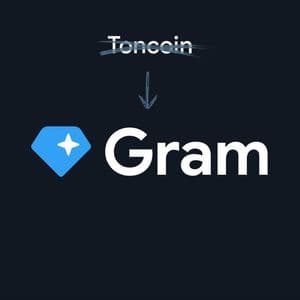
The TON Foundation is rebranding its native token from Toncoin to Gram, reviving the name attached to Telegram’s original 2018 blockchain project and signaling a deliberate push to convert the messaging platform’s 900 million monthly active users into on-chain participants. The change is cosmetic, no token swap, no technical migration, no new asset issuance, but the strategic logic is anything but superficial. The rebrand arrives as Telegram founder Pavel Durov frames the rename as step four of seven in his publicly stated ‘Make TON Great Again’ roadmap, with steps five through seven still undisclosed. The compounding dynamic here is regulatory history. Gram was the name at the center of a landmark SEC enforcement action that forced Telegram to return $1.2 billion to investors in 2020. Reviving that name is a calculated bet that the current TON ecosystem has enough structural distance from that legal episode to reclaim the brand without inheriting its liability. Discover: The Best Crypto to Diversify Your Portfolio Gram’s History: $1.7B ICO, SEC Intervention, and the Rebrand From Toncoin That Brings It Full Circle The transmission mechanism from name change to user acquisition is straightforward: reduce the cognitive gap between Telegram’s brand identity and its native crypto asset. Toncoin meant nothing to a first-time Telegram user. Gram, short, familiar, tied to Telegram’s original vision – does. The historical weight behind that word is significant. Telegram raised approximately $1.7 billion through private token sales tied to Gram in 2018, positioning it as the currency layer for the Telegram Open Network. The SEC intervened in 2019, alleging the offering constituted an unregistered securities sale. Telegram settled in 2020, agreeing to return roughly $1.2 billion to investors and pay an $18.5 million civil penalty, then stepped away from the project entirely. The network survived through open-source development and community stewardship, eventually relaunching as The Open Network under the TON Foundation, with Toncoin as its community-run asset. Source: Pavel Durov Official Telegram Channel Now, with Telegram intending to become the primary ecosystem administrator and largest validator, a governance shift explicitly flagged in the MTONGA roadmap, the ecosystem is reasserting its original identity while structurally differentiating itself from the entity that faced SEC enforcement. The rebrand rolls out over approximately three weeks across wallets, infrastructure providers, and ecosystem applications. User balances, staking positions, and network operations remain unchanged throughout. 900 Million Users as Addressable Market: What the Gram Rebrand Actually Unlocks Telegram’s monthly active user base is one of the largest untapped crypto distribution channels. The structural opportunity is not speculative; it is conditional on conversion rates. If the TON ecosystem converts even 1% of Telegram’s active base into regular Gram wallet users, that is 9 million participants, a figure that rivals the active user counts of several top-ten blockchain networks. 24h 7d 30d 1y All time The friction point has always been brand coherence. Telegram users encounter TON Space wallet, mini-apps, and bot-based payment tools that reference a token called Toncoin with the ticker TON, a label that carries no intuitive connection to the Telegram product they already use daily. Gram closes that gap. The analogy to WeChat Pay’s embedded finance model is instructive: WeChat did not ask users to understand digital payments architecture; it made transacting feel native to the messaging interface. Gram positions The Open Network to pursue an equivalent integration depth inside Telegram’s super-app environment, covering payments, gaming, stablecoins, and mini-app monetization. Market participants responded immediately. Toncoin surged 19% following the announcement, reaching approximately $2.21 in early trading before retracing toward $2.00. Discover: The Best Token Presales The post Toncoin (TON) Revives ‘Gram’ Token Name in Bold Bid to Own Telegram’s 900M Users appeared first on Cryptonews .
2 Jun 2026, 05:35
TON Holders Back Gram Rebrand as Price Climbs 5%

The rebrand received strong community support, with nearly 80% of pledged voting power backing the change. Telegram founder Pavel Durov said the move is a return to the project’s roots and will not require any token swaps or technical changes. TON Revives Original Gram Name The Open Network (TON) is preparing for one of the biggest branding changes in its history, with plans to rename its native cryptocurrency from Toncoin (TON) back to Gram (GRAM), which is the name that was originally outlined in Telegram’s first white paper. The proposal is currently being voted on by the community, and has already received overwhelming support, with nearly 80% of pledged voting power backing the rebrand. Telegram founder Pavel Durov announced the move as a return to the project’s origins, and stated that Gram was the original name of the network’s currency before regulatory challenges forced a major shift in the project’s direction. The name was abandoned after the US Securities and Exchange Commission halted Telegram’s $1.7 billion token sale in 2020, leading Telegram to step away from the project and allowing the community-driven TON Foundation to continue development independently. Telegram post by Pavel Durov According to Durov, the transition to Gram is expected to take approximately three weeks and will not require any action from token holders. The Open Network explained that there will be no token swap, migration, bridge, claim process, or conversion event. Wallet addresses, balances, smart contracts, and network positions will remain unchanged. This means that the rebrand is purely a naming update rather than a technical overhaul. The announcement was made shortly after Telegram assumed a more prominent role in the ecosystem, becoming the network’s primary driver and largest validator. The rebrand is also part of the “Make TON Great Again” roadmap, which already included major network improvements like Catchain upgrades designed to increase throughput, lower transaction fees, and deeper integration with Telegram’s ecosystem. TON plans to transform Telegram’s billion-user messaging platform into a Web3-powered super app capable of supporting payments, digital ownership, mini-applications, AI agents, and decentralized services. Supporters believe the Gram brand better reflects the project’s original vision and could help strengthen its identity as it enters this next phase of development. TON’s price action over the past 24 hours (Source: CoinCodex) Traders responded positively to the news. Over the past 24 hours, Toncoin climbed by approximately 5% , rising to around $2.06. The token experienced a sharp rally surging from the $1.93 range to above $2.20 before consolidating. Although some profit-taking followed the spike, TON managed to hold on to a portion of its gains.

